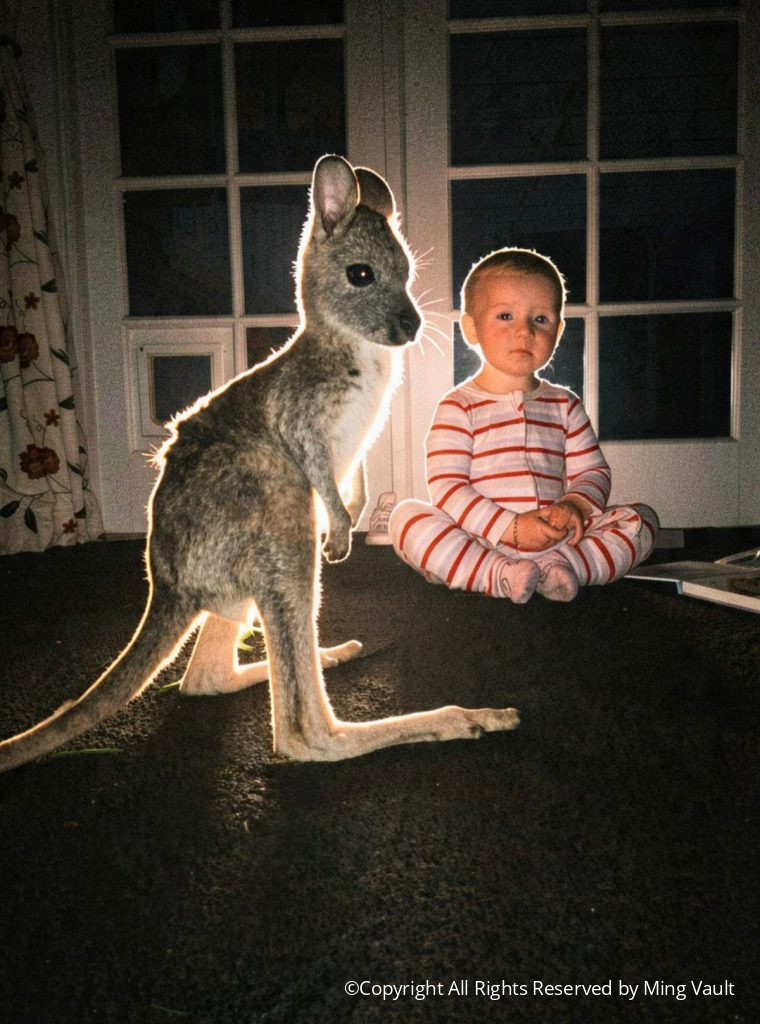
Childhood photographs often become meaningful because they preserve moments that cannot easily be recreated. In this image, the combination of a young child, a kangaroo, and an ordinary domestic environment produces a scene that immediately feels unusual yet surprisingly peaceful.
The kangaroo dominates the foreground with its upright posture, long tail, powerful legs, and alert ears. Beside it, the child sits cross-legged with hands resting together, creating a much quieter silhouette. The difference in size provides a strong visual contrast while keeping both subjects connected within the composition.
One of the photograph’s most distinctive characteristics is its lighting. A bright source positioned behind the subjects creates a glowing rim around the kangaroo’s fur and softly illuminates the child. The surrounding darkness makes this outline particularly noticeable and gives the photograph an almost cinematic atmosphere.
The domestic surroundings contribute another layer to the story. Windows, curtains, furniture, and the dark floor establish an unmistakably indoor setting. Because kangaroos are usually photographed in open natural landscapes, seeing one within a household environment creates an immediate sense of visual surprise.
Despite the unusual circumstances, there appears to be little urgency in the captured moment. The child remains seated while the animal stands nearby, and this stillness gives the photograph much of its emotional character. Rather than relying on action, the image invites viewers to observe the relationship between the two subjects.
Their different expressions also encourage interpretation. The kangaroo appears attentive to its surroundings, while the child looks directly toward the camera with a composed expression. Together, they create the impression of two individuals briefly sharing the same space while experiencing it in completely different ways.
From a photographic perspective, the image demonstrates how contrast can strengthen storytelling. Differences between human and animal, childhood and wildlife, interior darkness and intense backlight all contribute to a composition that is immediately recognizable and difficult to forget.
Such photographs can also encourage broader appreciation for wildlife and the responsibilities associated with close encounters. Wild animals have specific behavioral and environmental needs, making appropriate supervision and respectful treatment particularly important whenever humans interact closely with them.
Ultimately, the photograph succeeds because it preserves something both extraordinary and simple. There is no elaborate scenery or complicated action—only a child, an animal, dramatic light, and a brief moment of stillness that becomes a distinctive visual memory.
©2015 Copyright All Rights Reserved by Ming Vault