


Across the vast landscapes of the modern world, the nature of defense and security continues to evolve at an extraordinary pace. Technological innovation, strategic planning, and operational coordination have transformed the way organizations prepare for challenges in increasingly complex environments. What once relied primarily on manpower and conventional equipment now incorporates sophisticated digital systems, autonomous technologies, and advanced communication networks capable of reshaping the future of modern operations.
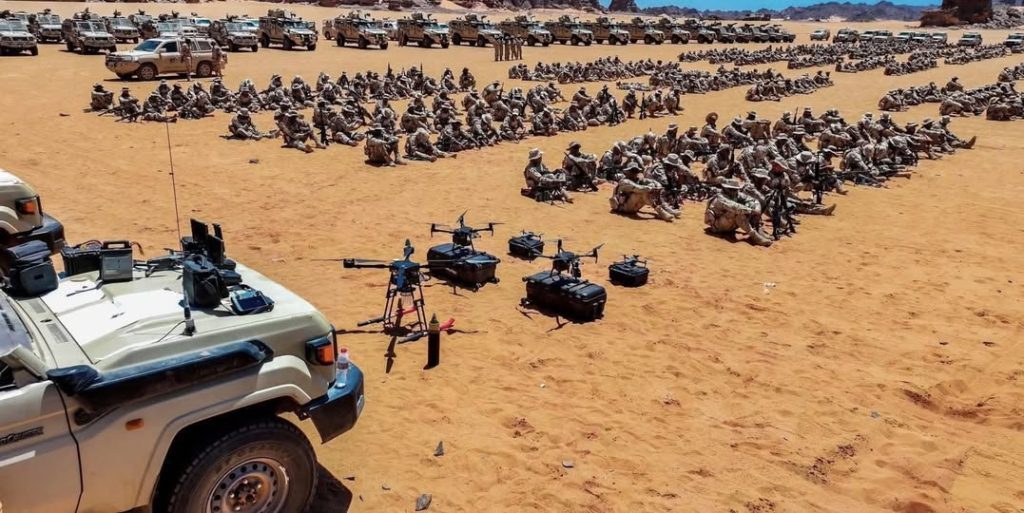
The image presented here offers a striking visual representation of this transformation.
Set against a dramatic desert backdrop, the scene combines large-scale personnel formations, specialized vehicles, and unmanned aerial systems in a display that highlights the growing integration of technology into contemporary operational planning. The image reflects not only logistical organization but also the broader evolution of strategic thinking in the twenty-first century.
For centuries, geography has influenced the development of military and security strategies. Deserts, mountains, coastlines, and urban environments each present unique operational challenges that require specialized preparation and adaptation. The environment shown in the image symbolizes one of the world’s most demanding terrains—an expansive landscape where endurance, coordination, and resource management become essential components of success.
Operating effectively in such environments requires more than equipment alone.
It requires preparation.
It requires training.
It requires leadership.
And increasingly, it requires technological innovation.
One of the most compelling aspects of the image is the visible presence of unmanned aerial systems positioned in the foreground. These platforms represent one of the most significant technological developments of recent decades. Advances in autonomous systems, aerial monitoring, remote sensing, and real-time data collection have dramatically expanded the capabilities available to modern organizations.
The integration of these technologies illustrates a broader trend occurring across industries and institutions worldwide. Information has become one of the most valuable strategic resources. The ability to gather, process, analyze, and distribute information rapidly can influence decision-making, improve efficiency, and enhance situational awareness.
The image captures this intersection between traditional operational methods and emerging technological solutions.
Another significant theme suggested by the scene is coordination.
Large-scale activities require extensive planning and organization. Personnel, vehicles, equipment, communications systems, and support resources must operate together within a unified framework. Effective coordination transforms individual components into a cohesive capability capable of responding to complex challenges.
This principle extends far beyond defense environments.
Successful organizations in business, government, healthcare, and technology all rely upon coordination to achieve their objectives. The image therefore symbolizes not only operational readiness but also the universal value of teamwork and strategic planning.
The desert setting further emphasizes the importance of adaptability.
Throughout history, challenging environments have tested human ingenuity and resilience. Extreme temperatures, vast distances, and limited resources require innovative approaches to logistics, communication, and operational management. Organizations that succeed in such conditions often do so because they embrace flexibility and continuous improvement.
The visual narrative reflects this spirit of adaptation.
The combination of advanced technology and human expertise demonstrates how innovation can help address complex environmental and operational challenges.
Another powerful theme within the image is preparedness.
Preparedness involves far more than reacting to events.
It involves anticipating possibilities.
It requires evaluating risks.
It demands investment in training, infrastructure, and capability development.
The image symbolizes this proactive approach to planning. Every vehicle, system, and individual visible within the scene represents a component of a larger effort focused on readiness and effectiveness.
The presence of modern vehicles and technological platforms also highlights the growing importance of mobility and connectivity in contemporary operations. Rapid movement of personnel and equipment, supported by reliable communication systems, allows organizations to respond more effectively to changing circumstances.
In today’s interconnected world, speed and information often work together as critical strategic advantages.
The image also reflects the relationship between technology and human decision-making.
Despite remarkable advances in automation and digital systems, people remain at the center of every major operation. Technology provides tools, insights, and capabilities, but leadership, judgment, and experience continue to guide decisions.
This balance is one of the defining characteristics of modern strategy.
Technology enhances human potential.
Human expertise directs technological capability.
Together, they create more effective solutions than either could achieve independently.
Throughout the visual composition, there is a strong sense of scale and organization. The orderly arrangement of personnel and equipment conveys discipline, structure, and purpose. Such imagery reminds viewers that large-scale endeavors depend upon planning, commitment, and shared objectives.
Beyond its immediate subject matter, the image encourages broader reflection on innovation and progress.
How will emerging technologies continue to transform operational environments?
What new capabilities will shape future strategies?
How can organizations balance technological advancement with human expertise?
These questions remain relevant not only within defense sectors but across nearly every area of modern society.
Ultimately, this image is about more than equipment, vehicles, or technology. It is a visual representation of preparation, coordination, innovation, and adaptability. It highlights humanity’s ongoing effort to combine knowledge, technology, and strategic thinking in pursuit of greater effectiveness and resilience.
In an era defined by rapid technological change, the ability to integrate advanced systems with skilled leadership and organized teamwork will remain one of the most important factors shaping the future. Through its powerful imagery and symbolic significance, this scene offers a compelling glimpse into that evolving landscape.
©2020 Copyright All Rights Reserved by Ming Vault.

